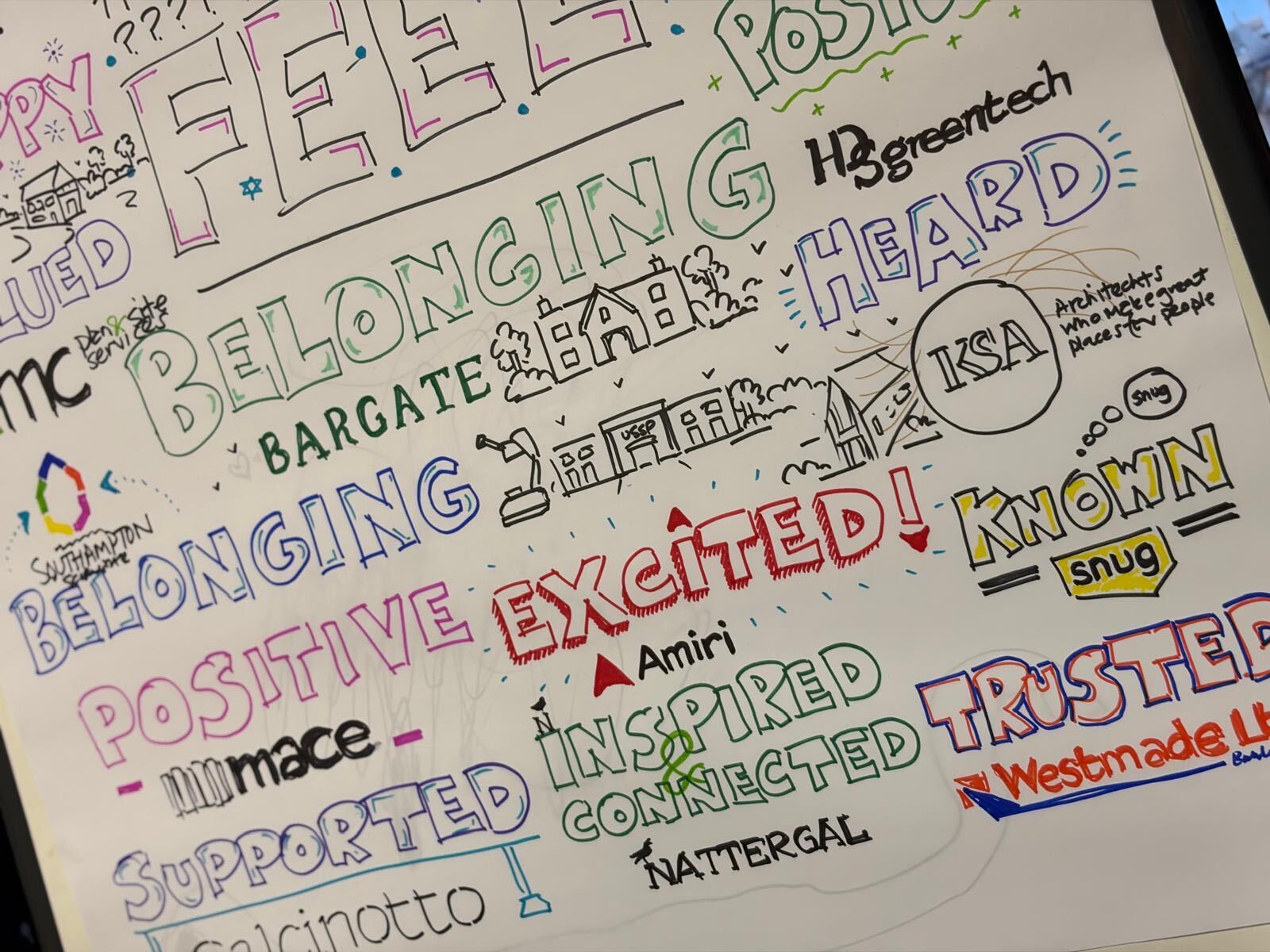

At this year’s South Coast CPS Conference, we asked people a simple question: how do you want people to feel about your brand?
As the conversations unfolded, I captured their answers on a hand-drawn canvas. Belonging. Confidence. Valued. Safe. Inspired. Connected.
The words came from people across different businesses, but they opened up a question relevant to any place brand: what are you doing to make that feeling real?
A word is a starting point
Most organisations can describe the feeling they want to create. A hotel wants guests to feel welcome. A developer wants buyers to feel confident. A destination wants people to feel excited about visiting.
The harder part is recognising what creates that feeling, and whether your brand is helping.
“Welcoming” might be the ambition. But if the website leaves basic questions unanswered, the photography shows only one kind of visitor and the first enquiry goes unnoticed, people have little reason to feel welcome.
The feeling takes shape in the details. Three words from the board show how that thinking can guide a brand.
Belonging: can people picture themselves here?
Belonging appeared more than once on the board. It’s a powerful ambition for a place, whether someone is choosing a home, a workplace or somewhere to spend their time.
Before they arrive, your brand gives them clues about whether it’s somewhere for them.
Who appears in your photography? What does your language assume about the reader? Do you show how people use the place, or mainly the buildings and facilities?
A development can talk about community while showing very little of the life someone could have there. A hotel can promise a warm welcome while presenting beautiful interiors with no human connection to the experience.
Brand thinking helps you decide who you’re inviting in, then express that invitation in ways they can recognise.
Confidence: have you given people enough to go on?
Choosing a place often involves uncertainty. Will this be right for us? Is it worth the money? Can we trust what we’re being told?
Your communications can help people answer those questions.
For a homebuyer, that might mean a dedicated development website, emotive community-led storytelling and an enquiry process that makes the next step obvious. For someone booking a stay, it could mean useful room information, honest imagery and clarity about what’s included.
Confident language alone won’t create confidence. People need information and evidence that support the promise.
That’s where strategy, messaging, creativity and experience need to work together: making the choice easier to understand and easier to trust.
Valued: does the experience acknowledge the person?
It’s easy to say that people matter. The test comes when they need something from you.
Can they find the answer to a straightforward question? Does an enquiry receive a timely and useful response? Do your communications recognise where they are in their decision process, or send everyone the same sales message?
For a place brand, feeling valued can begin long before a visit. It might be an accessible website, a helpful booking confirmation or information that anticipates a concern.
Marketing helps set that expectation. The wider team needs a shared understanding of how to carry it through.
The commercial question behind the feeling
These words matter because choosing a place is a human decision with commercial consequences.
Someone who can picture themselves there has a reason to explore further. Someone who feels confident has fewer unanswered questions standing between interest and an enquiry. Someone who feels valued has a reason to continue the conversation.
Our feeling canvas at the conference wasn’t a research study. It was an invitation to talk. But it gave us a useful starting point for the work that follows: connecting the feeling a business wants to create with the brand people actually encounter.
What makes your feeling real?
Choose one word from the board – or one of your own – and look at your brand through that lens.
Where does it already come through? Where does someone have to take your word for it? What could you change to make it more tangible?
That’s a useful place to begin.
How do you want people to feel about your place?
We’ve developed feel.forward™, a brand sentiment diagnostic that explores how your brand comes across today, how you want people to feel, where the gaps might be and how to close them. Get in touch to arrange a diagnostic for your brand and talk through what it reveals.