feel.forward™
How does your brand actually feel?

Who chooses you and not your competitor, and what makes them come back, is largely influenced by how your brand makes them feel.
People decide with their gut and justify it afterwards. feel.forward™ finds the gap between your brand sentiment today and the feeling your growth depends on, builds the brand to close it, and measures what moved, so brand spend stops being a matter of opinion.
The questions most brands can’t answer
People form a view of your brand before they speak to you: through reviews, search, recommendations and a dozen fragments you didn’t write. By the time they’re weighing you up, most of that feeling is already set.
AI assistants draw on the same proof — reviews, recommendations, what’s written about you elsewhere. How your brand is felt by customers and employees now shapes whether it gets found at all.
So when enquiries stall, or people don’t return and don’t recommend you, it looks like a marketing problem. Often it starts as a feeling problem.
You probably can’t say what feeling your brand actually creates, whether you’re remembered when it matters, or whether the experience holds together well enough to bring anyone back.
That’s the expensive part. Budget goes on work nobody can judge, while the issue costing you customers goes unnamed.

2x
the profit
Emotional advertising is twice as efficient as rational, and delivers twice the profit.
Thinkbox / IPA — Binet & Field, The Long and the Short of It
52%
more valuable
Fully connected customers are worth more than merely satisfied ones.
Four pillars, four scores – what it means
Your journey starts with agreeing your Feel Type – one of eight core feelings that translate into real customer action for brands. Our Brand Sentiment Report scores your brand’s reviews, comments, socials and your own written word against this target instead of a generic standard. Brands who feel dependable are very different to brands that feel exciting.
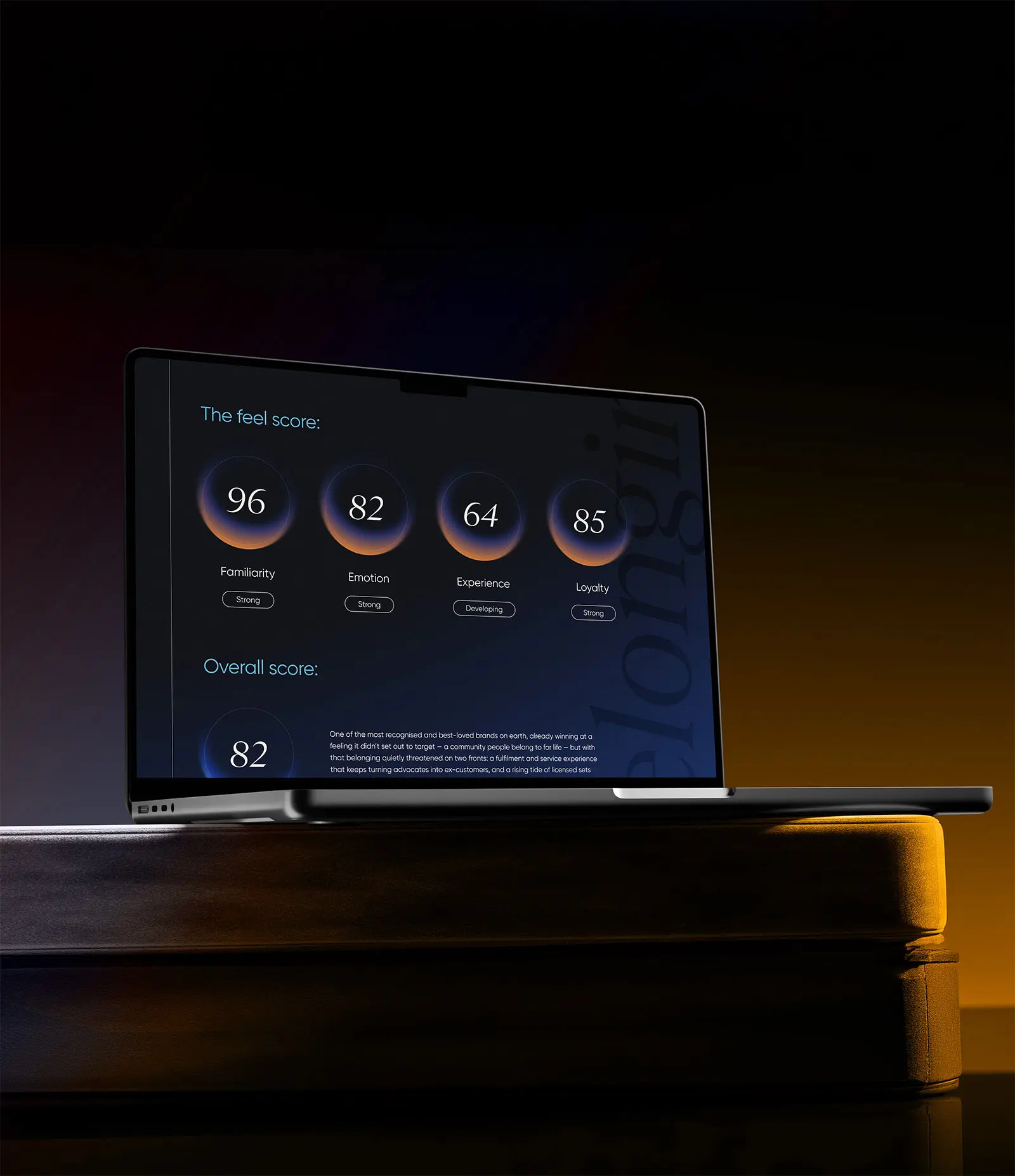
Next, we measure four pillars. Because a feeling has to survive four tests before the commercial work can begin.
Familiarity
Do you come to mind when someone is actually making a decision? That’s the difference between being seen and being felt.
Emotion
Do people feel the way you intended? We analyse the language customers use in reviews and comments against the feeling you’re aiming for.
Experience
Do you feel like the same brand everywhere? People notice inconsistency long before they can explain it, and credibility goes with it.
Loyalty
Do people feel strongly enough to come back and bring someone with them? Satisfaction without attachment reads well on a feedback form and shows up nowhere in the numbers. Start building advocates, not customers.
Each pillar is scored out of 100, against your target Feel Type and your competitors. The insights matter more than the total: a brand adored by the few who find it has a very different problem from one everybody knows, and nobody feels strongly about.
How it works
Four stages, one recurring loop. Each one sets up the next, and the last one starts the process again. This stops brand work from being a project you finish, and wonder about its impact six months later, and transforms it into continuous improvement
01
Diagnose the feeling
We read your brand from the outside in: reviews, social, search, your own language, and the same measures for your competitors. You get a scored diagnostic across all four pillars, benchmarked against your target feeling and the market around you.

02
Decide what moves first
We sit down with the findings and agree which one or two gaps to close, weighing the size of each against what it’s costing you. Success gets defined before anything is designed, which is the bit most brand projects skip.

03
Do the work
Strategy, identity, messaging, digital and marketing, all briefed against your target feeling rather than against instinct. Every decision has something to answer to, so the work can be judged on whether it lands the feeling you chose.

04
Measure the shift
We score the same four pillars again, the same way, so movement is real rather than a trick of measuring differently. You see what moved, what didn’t, and where the next round of work should go.

05
Repeat the cycle
Then it starts again, and the second review is sharper than the first. This time you know what you’re looking for. Unlike traditional brand sentiment tracking, every loop identifies opportunities to improve; every loop gets your customers closer to your brand.

The science behind
Then it starts again, and the second review is sharper than the first. This time you know what you’re looking for. Unlike traditional brand sentiment tracking, every loop identifies opportunities to improve; every loop gets your customers closer to your brand.
Less guesswork. More direction. Better results.
Everyone ends up with the same picture of what the brand needs to achieve.
Not just a brand that looks different. A brand people feel differently about.
Curious what we’d find in your brand? Start with a sample from your chosen sector, scored the same way we’d score yours.